Wednesday, March 18, 2015

Used Heed Lens Bellows

Used Heed lens bellows. 77mm adapter. Very good condition.
Tag #2143, #2144                                                       $40.00


Used Mamiya 100-200mm f/5.2 Camera Lens


Used Mamiya 100-200mm f/5.2 Lens. Comes with front with and back cap and lens support bracket. Very good condition.
Tag #2136                                                                                               $199.00

Used Mamiya RZ Pro II

 Used  Mamiya RZ 67 Pro II  with  front body cap and 120 film back.   Very good condition
Tag # 2134                                                                            SOLD                       $400.00

Monday, March 16, 2015

Red Light in a Dark Room - Part 16

This week we are excited to bring you a new installment from our series all about Stephen's darkroom and soon to be darkroom. Sounds like a very unique set up! We'd love to see photos once the new kitchen darkroom is going! Thanks a lot, Stephen.

What is your darkroom? A room, closet or bathroom? Please tell us a bit about it.

My darkroom consists of two moving blankets on either side of my windowless bathroom door, for the time being. I have recently purchased some blackout fabric. The panels are going to be sewn together to create walls and are then going to be attached, floor to ceiling, with 2” Velcro around my kitchen. It will have everything I need in there. Ventilation (oven fan), Wet side (sink) and Dry side (counter space). Now I just have to figure out where I am going to do my cooking. Yes I live alone.

What's your process? Tell us a bit about your developing routine, especially if it's tricky.

My process is very standard. I use Paterson tanks and reels in 35 and 120 formats. I always pre-soak the film for 1 minute or so in 20.5-21C water then add my 20C developer. I agitate by inversion continuously for the first minute then 1 inversion every 30 seconds thereafter. My stop bath is also at 20C, continuous agitation for 1 minute and the fix is somewhere close to 20C, continuous agitation for the first minute and 1 inversion every 30 seconds thereafter again. The film is rinsed thoroughly in water. I then let it sit in a water bath for 10 minutes and repeat this step 3 times for a total of 30 minutes. I am trying to reduce the amount of water I use. Then hang to dry in my bathroom that I had a shower in to get any dust down.

I also stand develop film and love the results with this process. I will let it sit for 60, 90, 120 minutes, just for fun. I have even put borax in my developer at times and I am going to try using salt water with my developer as well just to see what happens.

I will cross process anything by stand developing.

What is your go to developer?

My go to developer is Blazinal. Love this stuff. I just purchased some Xtol and mixed that up the other day.

I will shoot a roll of 35mm film of 24 or 36 exposures, go in my darkroom and cut the film in half, put each half on a separate spool and process in different developers.

What is your all-time favorite Film/Film developer combo?

I haven’t figured that out yet.

I jump around with so many different combinations. I use Blazinal and Xtol, which I mentioned, as my developers and I shoot Ilford Pan F, HP5+ and Delta 100. In Kodak stock I use Tri X 400.

What result/look does this give?

So far the look that I am achieving with all these different combinations is just what I have been hoping for, Black, White and a bunch of different tones of grey.

I need to focus on one developer and one film for a while to find what really speaks to me. I am going to work with Blazinal, HP5+ and see what happens.

Have you tried any or are you into any alternative processes, such as cyanotype?

I have played around with the gum dichromate process and produced one piece from that. When the time comes I will do more of it but for now I am consumed with the B&W process.

What is the best processing tip you can give?

Don’t be afraid to make mistakes. Film is cheap and even mistakes are to be learned from. Experimentation keeps things from getting stale.

Don’t drink anything when you are in the darkroom!!!


Below is a sample of the Gum print Stephen tried out.


Monday, March 9, 2015

Red Light in a Dark Room - Part 15

For this week's Red Light in a Dark Room we are very happy to learn more about Russel and Wendy's wonderful home darkroom.

Wendy and Russel Kwan are fine art photographers, exclusively producing their limited-edition work as toned fiber-based silver-gelatin prints in their studio and darkroom. Their work has been exhibited in Canada and the US in commercial and academic museums and galleries. Their next scheduled solo show, "Space + Time" will be at Visual Space Gallery in Vancouver, 21 Aug to 5 Sep 2015. They are the black-and-white darkroom instructors in Continuing Studies at Langara College (next course "Basic Darkroom PHTG 1003" starts Tue 5 May 2015), and independently operate their Photography MicroSchool (these courses have nothing to do with darkrooms!) in Vancouver (next courses start in May 2015).

What is your darkroom? A room, closet or bathroom? Please tell us a bit about it.


We have a darkroom tour page on our website: http://NewMythographs.com/pages/rwpMainframeDarkroom.html .

Our darkroom is a purpose-built 9x13 foot room with a custom stainless-steel sink running the length of one side, and cabinets / enlarger workstation on the other. It is built for efficiency, so we can make mistakes really fast.

What's your process? Tell us a bit about your developing routine, especially if it's tricky.

We use a variety of processes, including some secret home-brew chemistries - but the basic stuff is what many people use: Paterson tanks and reels and a traditional print tray-line. We do have a film processor for straight photography - it's a Photo-Therm SSK-8, and it's a trouper.

What is your go to developer?

Russ uses a variety of home-brews, none of which are published, as well as Kodak HC-110. HC-110 works much better when it's been aged a lot. So does Blazinal. Wendy uses Ilford Perceptol.

What is your all time favorite Film/Film developer combo?

Russ uses HP5 & HC-110, and Rollei IR & HC-110 a lot. Wendy uses Delta 400 & Perceptol, and Ilford SFx & Perceptol. It probably should be noted that we don't use any film or chemistry (other than fixer) according to the manufacturer's instructions.

What result/look does this give?

It's a total light-path thing. Everything matters, from lens to camera to film-format & film to development regime to enlarger type to enlarger lens to print paper to print processing to toning. Neither of us has a single "look" - rather, we invent new looks for every body of work. There's no way to assess a look online - to see it, you'll need to see the finished prints.

Have you tried any or are you into any alternative processes, such as cyanotype?

We've tried lots of things, including gum, lith and cyanotype - but silver remains the most flexible and malleable medium for both of us. Home-brew chemistry can totally transform silver, allowing the medium to do completely new things.

What is the best processing tip you can give?

Keep ridiculously complete and detailed notes. Be consistent with everything. Change only one thing at a time. Make copious mistakes and keep close track of the cool ones. Bravely and ceaselessly experiment.

Tuesday, March 3, 2015

Clearance Balcar Light Kit

Balcar Concept 3 Battery 2-Head light Kit: Great deal on this Balcar unit. Floor model light demo use only.  Fantastic for location shoots. 4800 w/s (Three 1600 w/s heads) with variable flash duration. Regular $4299.00 Clearance price, Way below cost $ 2899.00 New Lower  price $2000.00

Clearance: Norman12/12 Kit

Norman P12/12 Kit : New floor model.  1200 w/s, Symmetrical and asymmetrical light distribution. Power trim up to a 3-stop range, Built in photo eye (switchable), visible and audible ready indicators (switchable) , fan cooled, fast recycling 1/5th to 2 seconds. Dual voltage. Compact 7"x7"x8" and weights only 12 lbs., 1 year warranty. Comes with 1-LH2400 head .

Regular price $2799.95  Clearance $1200.00  SOLD

Red Light in a Dark Room - Part 14

Thanks a lot to Nigel for his great darkroom info this week! It's interesting to learn about some different alternative processes as well.
 
What is your darkroom? A room, closet or bathroom? Please tell us a bit about it.

I'm fortunate to have light-proof, interior bathrooms in the places I've lived - which makes handling film, controlling dust and keeping a steady temperature a lot simpler. With 4x5 film I'm really careful about dust, a bit OCD with vacuuming the bathroom ceiling to floor, the film holders, the camera and so on.
 
I've drifted away from silver-gelatin printmaking over the years but after seeing Lee Freidlander's wonderful show at Presentation House, I'm seriously thinking about squeezing a 4x5 enlarger into that bathroom.

What is your process? Tell us a bit about your developing routine, especially if it's tricky.

There's nothing very special about my developing routine. Good control over the processing time/temperature is the most important thing. Lately I've been using a cool little iPhone custom timer app from Kodak Film which beeps on cue and has a safelight display. To control temperature, I start with the room - I aim to keep temp in the bathroom at 20C, and stand my processing drum, chemicals and large bucket of water in the room overnight, so everything is at 20C. I use that water to make up the develop/fix solutions, also for a rinse to halt the development. Sometimes in colder weather I'll use an aquarium heater to maintain the water temperature. I use a Jobo drum for 4x5 processing - nothing fancy, fill with a funnel and roll it gently back and forth on a towel on the floor. I also have a couple of reel/drum tanks for roll film. For washing, I use a Polaroid P/N film bucket, originally intended to hold and clear Polaroid Type 55 negs in the field. But it also works great to wash reels and sheet film. After washing under the tap (also around 20C but not so critical) for an hour or so, I dip the film in Photoflo solution and clip on a line rigged in the shower to dry overnight.

What is your go to developer?

Early on I tried Rodinal at 1+25 and I've stuck with that. I've also used Xtol for roll film, and have dabbled with PMK (pyrogallol metol staining developer) under full hazmat protocols :-)

What is your all time favorite Film/Film developer combo?

HP5+ and Rodinal.  

What result/look does this give?

HP5+/Rodinal gives me a solid 4x5 neg with good density and tonal separation in the mid and light grays. The light and shadows here on the west coast are fairly blue - especially strongly lit seascapes/mountainscapes - so I generally use a 2-stop yellow-orange lens filter to improve sky definition and shadow contrast. With HP5+ I end up with a handy working speed of 100 after the filter factor; with Rodinal the whole analog image chain just seems to fall into place.

Have you tried any alternative processes, such as cyanotype?

I've experimented with PMK processing and the ziatype (platinum/palladium) printing process to make 4X5 contact prints. It's a neat but finicky process that relies on a slightly damp paper emulsion. It's quite a bit of work to get the paper and coating routine dialed in. I also ended up building a UV light hood to guarantee a source of "sunshine". But the prints turn out to be wonderful, gloriously tactile objects.

I’m very attached to polaroid processes and have had some nice results using the Impossible SX70 film. I sincerely hope the New55 project eventually comes to fruition - I have about a box and a half of old and now rather dodgy Type 55 left - it's a bit of a personal ritual for me to expose a few sheets every year just for the experience.

What is the best processing tip you can give?

Be methodical and keep notes. Get a good thermometer! Have fun and don’t process any critical images until you’re well dialed in.
 
 
Here area  few examples of Nigel's work.
 
For more, check out his website: atmosphericlens.com
 
 
HP5 in Rodinal


HP5 in PMK


HP5 in PMK/Ziatype Print


Friday, February 27, 2015

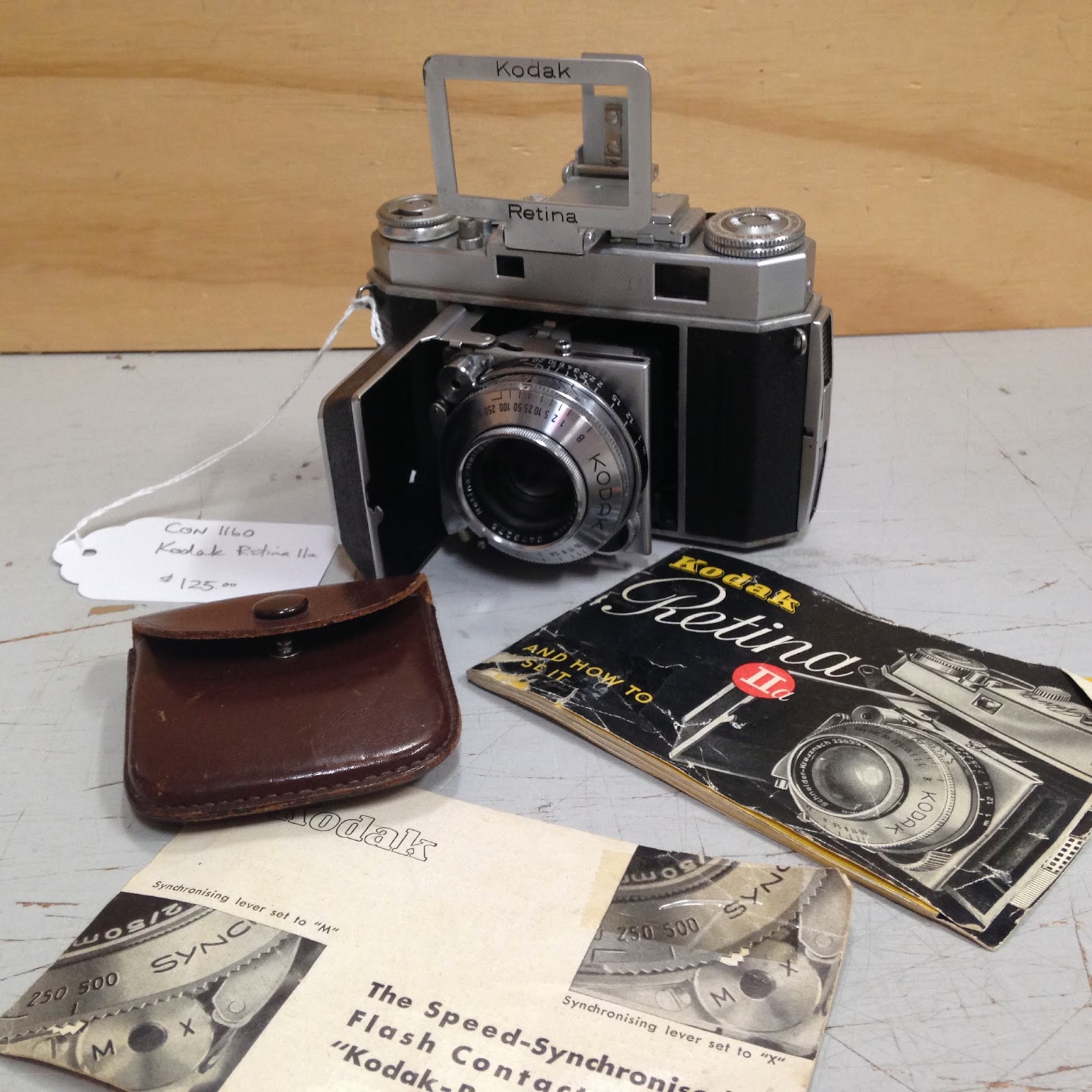
Kodak Retina IIa - NO LONGER AVAILABLE -but still cool!


This sweet little 'made in Germany' rangefinder is new to our consignments. I believe this model is 1950s era. What I find so cool about it is fact that it takes 35mm film and folds up, becoming the perfect vintage pocket camera.

Harman Inkjet Paper

A while ago I decided I wanted to see my Impossible Project emulsion lifts printed larger on fine art inkjet paper. A friend of mine recommended Harman inkjet paper. Looking at Harman's inkjet paper sample book I noticed they had a great selection of paper surfaces, everything from matt to high gloss finishes, smooth to textured. After a bit of research I went with their Matt Cotton Smooth 17x22. I found that I really liked how the Matt Cotton Smooth seemed to make the lifts look like they were a part of the paper not just ink sitting on top of a surface.

Since then I have gotten stock on the Harman Inkjet papers for Beau Photo Supplies, we now regularly carry the Matt Cotton Smooth, Gloss Baryta and Gloss Art Fibre in 8.5x11, 13x19 and 17x22. There are five other choices such as, Matt Fibre Duo, Matt Cotton Textured, Gloss Art Fibre Warmtone, Gloss Baryta Warmtone, and canvas that are easy enough to special order in. 

Here are some examples of the different papers and I have taken photos of them at a certain angle with the light hitting them so you can actually see the texture (or lack there of) on each of them. Most of these photos are also very close up too, in the hopes you can get a sense of what the texture looks like. We have sample books in store so you can feel them and see them in person however!


Gloss Art Fibre. 300 gsm, 100% alpha-cellulose, white, glossy.


Gloss Art Fibre Warmtone. 300 gsm, 100% alpha-cellulose, warmtone, glossy


Gloss Baryta. 320 gsm, 100% alpha-cellulose, white, glossy


Gloss Baryta Warmtone. 320 gsm, 100% alpha-cellulose, warmtone, glossy


Canvas. 450 gsm, poly-cotton, white


Matt Cotton Textured. 300 gsm, 100% cotton, white


Matt Cotton Smooth. 300gsm, 100% cotton, white.


An interesting bit of trivia I learned while researching Harman Inkjet paper is that the name Harman is the surname of the founder of Ilford, Alfred Harman. 

Also that Hahnemuhle and Harman paired up to produce this paper together which is how they have had the ability to produce an inkjet paper that has the look and feel of traditional Ilford darkroom paper.