Showing posts with label Ilford. Show all posts

Tuesday, August 30, 2016

Photos from Argus Day 2016!

We hope all our fellow Argus lovers managed to get out and enjoy Argus Day! This year it fell on Argust 16th, 2016 and both Nicole & I managed to take our little Argus' out for a stroll. We were excited that so many of our film friends over here at Beau have Argus cameras as well and also got out there to shoot a couple of rolls! Check out a selection of our photos and those submitted by fellow Argus shooters below and feel free to still submit your Argus Day photos if you haven't already! You can email them to film@beauphoto.com.

For more info about this yearly event, check out our previous post too:

http://beauphoto.blogspot.ca/2016/08/get-ready-for-argus-day-2016.html

As well as the Argus Collectors Group page:

http://www.arguscg.org/

Check out their submissions for this year here:

http://www.arguscg.org/events/argusday/2016/


Nicole - Argus A - Kodak Commercial 200 135-8


Meghan - Argoflex 75 - Cut down roll of Fuji NHG 400 120 - (Bit of a light leak because it rolled onto the 620 spool very loosely!)


Bruce McLellan - Argoflex TLR & Argus A4


Argoflex TLR - Fuji Acros 100 120


Argus A4 - Kodak Pro Image


Troch - Argus 75 - Arista Edu Ultra 400 - Processed in XTOL stock for 8.25 minutes


Christopher Evans - Argus C3 Matchmatic, M450 & Super Seventy-Five

Argus C3 Matchmatic - Ilford Pan F film (expired 1990) - Developed in Diafine.


Argus M450 - Kodak T-Max 400 - Developed in Ilfotec DD-X


Argus Super Seventy-Five - Ilford Pan F Plus - Developed in Rodinal


Monday, April 20, 2015

Red Light in a Dark Room - Part 18

We're back this week with a new installment of our dark room series from Ron. Sounds like a good set up and a reoccurring theme in the advice column definitely seems to be STAY ORGANIZED and be meticulous about recording what you do. Thanks, Ron!

What is your darkroom? A room, closet or bathroom? Please tell us a bit about it.

When it comes to developing film I use my whole house. The Laundry room (loading reels), the Main Bathroom (for drying the film) and the Kitchen (for mixing the chemicals and "souping" the film).

My darkroom does double duty as a laundry room. It works well since it has no windows and I've set a curtain before the door so no light sneaks through from the outer hall. The top of the washer and dryer make a good large workspace. I haven't expanded into printmaking yet. (I have an enlarger and all the accessories, but I need to build a proper darkroom before I can use them.)

What's your process? Tell us a bit about your developing routine, especially if it's tricky.

I like to keep my process as simple as possible. I use two 2-reel Paterson tanks which I load in the darkness of the laundry room.

Before loading I check Massive Dev chart (http://www.digitaltruth.com/devchart.php) to ensure that the films I am developing have the same development times (not a concern for colour but important when developing black and white)

I make a note of each roll and its position in which tank.
ie. tank 1 - Top: HP5 - Olympus OM 10 - March 5 - Gastown

Bottom: HP5 - Canon QL17 - Feb 3 - Strathcona

I often check filmdev.org to see what other people are doing; but, for the most part, I like to stick to the tried and true methods found on the Massive dev chart website.

I don't do stand developing, not because I don't like it but because I haven't the patience to sit around waiting :) My general rule of thumb is agitate for the first 30 seconds and then 4 or 5 inversions every minute after that.

Sometimes I will pick up Ilfostop, but if I run out I do a water stop for two minutes (30 seconds agitation/empty/refill and repeat)

I use Ilford Rapid fix as my go to fixer and, even though it says three minutes is adequate, I like to fix for 6 - 7 minutes using the same agitation as in developing. I've read that it is difficult to over fix and I haven't yet.

Once the film is developed, I hang dry it in the main bathroom (I run the shower for about 15 minutes before hand to keep any dust from ending up on the film as it dries)

Once dry I scan it to my computer with an Epson V550 scanner and store the negatives in archival sheets and binders.
What is your go to developer?

I like Ilfosol 3 because it's low maintenance. I can mix it and go. Unlike a powder mixes like D76 where I have to mix it ahead of time and let it cool.

What is your all time favorite Film/Film developer combo?

I can't give an opinion on this as I haven't been doing this long enough to have experimented with different combinations. I often use whatever I have in the house. Currently I have enough Ilfolsol 3 for two more rolls and a liter of D76 mixed/ready to go. I just picked up 3 - 5L mixes of Xtol and am excited to give it a try.

What result/look does this give?

I will say this... When I've developed HP5 in Ilfosol 3, I've found the results to be grainy with a nice contrast; however, Ilfosol3 with Tmax 400 ended up with a nicer grain and less contrast. Now, take it all with a grain of salt since, like I said, I haven't got the years of experience that many, more knowledgeable, folks may have.

Have you tried any or are you into any alternative processes, such as cyanotype?

I haven't done anything like cyanotype, but I have had great fun playing with caffinol. If you're unfamiliar... Caffinol is a process in which you create your own developer using instant coffee, vitamin C, and washing soda. (It smells as revolting as it sounds) A great video can be seen at https://www.youtube.com/watch?v=zYjOqcbBEco and many different recipes and guides can be found at http://www.caffenol.org/

What is the best processing tip you can give?

1) Leave your phone, smart watch etc outside the darkroom! I learned this lesson a couple days ago when I forgot to take off my watch and, half way through loading some 120 film on a reel, it lit up.

2) Invest in a film puller - makes life soooooo much easier.

3) Set everything up the same way every time. Its so much easier to find the reel, scissors, film rolls etc... when you put them in the same place.

4) Label your film - often it will be weeks or months before you process some rolls (Gary Winogrand would let his film sit for a year) and it sucks trying to archive your stuff when you can't remember when/where the photo was taken, or what camera/ lens combo was used.

5) Make a note of what film is where in the tank and keep track of where it hangs when drying ( I work top to bottom/left to right - so when hanging the film the top roll in the tank is always on the left and the bottom roll is on the right (tank 1 is left, tank 2 is right.))


Monday, March 16, 2015

Red Light in a Dark Room - Part 16

This week we are excited to bring you a new installment from our series all about Stephen's darkroom and soon to be darkroom. Sounds like a very unique set up! We'd love to see photos once the new kitchen darkroom is going! Thanks a lot, Stephen.

What is your darkroom? A room, closet or bathroom? Please tell us a bit about it.

My darkroom consists of two moving blankets on either side of my windowless bathroom door, for the time being. I have recently purchased some blackout fabric. The panels are going to be sewn together to create walls and are then going to be attached, floor to ceiling, with 2” Velcro around my kitchen. It will have everything I need in there. Ventilation (oven fan), Wet side (sink) and Dry side (counter space). Now I just have to figure out where I am going to do my cooking. Yes I live alone.

What's your process? Tell us a bit about your developing routine, especially if it's tricky.

My process is very standard. I use Paterson tanks and reels in 35 and 120 formats. I always pre-soak the film for 1 minute or so in 20.5-21C water then add my 20C developer. I agitate by inversion continuously for the first minute then 1 inversion every 30 seconds thereafter. My stop bath is also at 20C, continuous agitation for 1 minute and the fix is somewhere close to 20C, continuous agitation for the first minute and 1 inversion every 30 seconds thereafter again. The film is rinsed thoroughly in water. I then let it sit in a water bath for 10 minutes and repeat this step 3 times for a total of 30 minutes. I am trying to reduce the amount of water I use. Then hang to dry in my bathroom that I had a shower in to get any dust down.

I also stand develop film and love the results with this process. I will let it sit for 60, 90, 120 minutes, just for fun. I have even put borax in my developer at times and I am going to try using salt water with my developer as well just to see what happens.

I will cross process anything by stand developing.

What is your go to developer?

My go to developer is Blazinal. Love this stuff. I just purchased some Xtol and mixed that up the other day.

I will shoot a roll of 35mm film of 24 or 36 exposures, go in my darkroom and cut the film in half, put each half on a separate spool and process in different developers.

What is your all-time favorite Film/Film developer combo?

I haven’t figured that out yet.

I jump around with so many different combinations. I use Blazinal and Xtol, which I mentioned, as my developers and I shoot Ilford Pan F, HP5+ and Delta 100. In Kodak stock I use Tri X 400.

What result/look does this give?

So far the look that I am achieving with all these different combinations is just what I have been hoping for, Black, White and a bunch of different tones of grey.

I need to focus on one developer and one film for a while to find what really speaks to me. I am going to work with Blazinal, HP5+ and see what happens.

Have you tried any or are you into any alternative processes, such as cyanotype?

I have played around with the gum dichromate process and produced one piece from that. When the time comes I will do more of it but for now I am consumed with the B&W process.

What is the best processing tip you can give?

Don’t be afraid to make mistakes. Film is cheap and even mistakes are to be learned from. Experimentation keeps things from getting stale.

Don’t drink anything when you are in the darkroom!!!


Below is a sample of the Gum print Stephen tried out.


Monday, March 9, 2015

Red Light in a Dark Room - Part 15

For this week's Red Light in a Dark Room we are very happy to learn more about Russel and Wendy's wonderful home darkroom.

Wendy and Russel Kwan are fine art photographers, exclusively producing their limited-edition work as toned fiber-based silver-gelatin prints in their studio and darkroom. Their work has been exhibited in Canada and the US in commercial and academic museums and galleries. Their next scheduled solo show, "Space + Time" will be at Visual Space Gallery in Vancouver, 21 Aug to 5 Sep 2015. They are the black-and-white darkroom instructors in Continuing Studies at Langara College (next course "Basic Darkroom PHTG 1003" starts Tue 5 May 2015), and independently operate their Photography MicroSchool (these courses have nothing to do with darkrooms!) in Vancouver (next courses start in May 2015).

What is your darkroom? A room, closet or bathroom? Please tell us a bit about it.


We have a darkroom tour page on our website: http://NewMythographs.com/pages/rwpMainframeDarkroom.html .

Our darkroom is a purpose-built 9x13 foot room with a custom stainless-steel sink running the length of one side, and cabinets / enlarger workstation on the other. It is built for efficiency, so we can make mistakes really fast.

What's your process? Tell us a bit about your developing routine, especially if it's tricky.

We use a variety of processes, including some secret home-brew chemistries - but the basic stuff is what many people use: Paterson tanks and reels and a traditional print tray-line. We do have a film processor for straight photography - it's a Photo-Therm SSK-8, and it's a trouper.

What is your go to developer?

Russ uses a variety of home-brews, none of which are published, as well as Kodak HC-110. HC-110 works much better when it's been aged a lot. So does Blazinal. Wendy uses Ilford Perceptol.

What is your all time favorite Film/Film developer combo?

Russ uses HP5 & HC-110, and Rollei IR & HC-110 a lot. Wendy uses Delta 400 & Perceptol, and Ilford SFx & Perceptol. It probably should be noted that we don't use any film or chemistry (other than fixer) according to the manufacturer's instructions.

What result/look does this give?

It's a total light-path thing. Everything matters, from lens to camera to film-format & film to development regime to enlarger type to enlarger lens to print paper to print processing to toning. Neither of us has a single "look" - rather, we invent new looks for every body of work. There's no way to assess a look online - to see it, you'll need to see the finished prints.

Have you tried any or are you into any alternative processes, such as cyanotype?

We've tried lots of things, including gum, lith and cyanotype - but silver remains the most flexible and malleable medium for both of us. Home-brew chemistry can totally transform silver, allowing the medium to do completely new things.

What is the best processing tip you can give?

Keep ridiculously complete and detailed notes. Be consistent with everything. Change only one thing at a time. Make copious mistakes and keep close track of the cool ones. Bravely and ceaselessly experiment.

Monday, February 23, 2015

Red Light in a Dark Room - Part 13

Thanks a lot to Joe for his very concise development routine for this weeks installment!


What is your darkroom? A room, closet or bathroom? Please tell us a bit about it.

I use a very large film changing bag as my darkroom, along with Paterson film tanks.

What's your process, talk a bit about your developing routine, especially if it's tricky.

Here is my routine, very simple and quick. I put my film camera in the changing bag, load the film into the Paterson tanks

Take the loaded tanks to my kitchen and start the process of development.

What's your go to developer?

Ilford Ilfotec DD-X

What's your all time favorite Film/Film developer combo? 

Ilford HP5 and Ilford Ilfotec DD-X

What result/look does this give? 
1950-1960 FILM LOOK

 Have you tried or are you into any alternative processes, such as cyanotype?

Yes, right now at this moment I just received my tintype kit so I’ll be doing Tintype this week. I am signed up for a wet plate collodian workshop in April that I am really looking forward to.

What is the best processing tip you can give?

Develop a routine, a method, a system, makes the workflow much easier.


Monday, February 16, 2015

Red Light in a Dark Room - Part 12

This week we hear from Kevin who has an interesting traveling dark room set up that he can take along on all his travels. Thanks for sharing with us, Kevin!


What is your darkroom? A room, closet or bathroom?

The kind of photography I have done for the last number of years might best be described as urban hiking. Therefore I need a camera that is simple, easy to use, can do both architectural photography, as well as point and shoot and doesn't weigh a ton! The answer I found was a Speed Graflex. These cameras are much underrated but nothing comes close for ease of use and versatility. I acquired one that was fully functional with a coupled rangefinder for less than $500 at an estate sale. One photo at the bottom is a hand held shot (boy on tightrope) and the other is of architecture.

I have shot large format for over 20 years and have learned if you want to survive at this sport you need to keep things simple and straightforward. After trying all kinds of exotic developing methods, I found that four sheets face up in the bottom of a tray works best. I made a special tray by gluing plastic guides to an old paper tray. As I often travel and needed a way to develop the film in the hotel bathroom - and this fits the bill.

What's your all time favorite Film/Film developer combo and what results does this give you?

My preferred film/developer combination is Ilford Delta 100 and Kodak Xtol. This gives a nice smooth evenly stepped tonal scale and allows for 4X enlargement of the negative without the grain showing. Although I have tried platinum printing, which produces a beautiful image, I find that having a large neg and then using split contrast printing produces what I am looking - generous detail.

What is the best processing tip you can give?

When it comes to processing film I have found that slow is best. I usually dilute the developer and use a semi-stand method when I have a 5 stop or greater of dynamic range. I keep the time negs are in the developer at about 30 minutes - which is sufficient for the negs to "stand" several times for 5 minutes preventing the highlights from going off the scale. When I have 4 stops or less then I use a 1:1 dilution, shorten the time and use continual agitation. Even though I use variable contrast printing I still follow the basic rule of 19th century photographers "expose for the shadows and develop for the highlights."

Below are a couple of examples from a recent trip to Lisbon.


Friday, February 6, 2015

Red Light in a Dark Room - Part 11

We've got a double dose of our darkroom series this week as Monday is a holiday in BC and we will be closed. We thought we'd give you some extra reading for the weekend!

Thanks a lot to Ben for sharing his darkroom set up with us and showing us that you can construct some of these things yourself with a little know how and determination!

What is your darkroom? A room, closet or bathroom?

About two years ago, after a hiatus from photography, I decided to buy myself a digital camera. It was my first digital camera and, really, I had no idea what to expect. The real excitement was in the thought of taking photos again. Once I got to shooting I found myself fairly bored with the digital process. A yearning for my old Pentax K1000 started to creep in and within a month my DSLR was up for sale and I was on the hunt for a manual film camera.

Once I found a camera, I wanted to start developing my own film, so I ordered the basics and made friends with my new darkroom – the bathroom. It was fun for a while until I wanted more out of my results. So, I decided that bigger was better, which is not necessarily true, and bought myself an iconic medium format camera; a Hasselblad 500 C/M. At this point, I switched from colour to black and white and was on the lookout for some instruction.

There is a lovely couple in town who teach darkroom courses at one of the local colleges. I signed up and started to delve into the process. It was there that I fell in love the art of black and white photography. It inspired me so much that I started to search out a place to build my very own darkroom. Going back to the bathroom was not going to be good enough anymore.

It was in August that I finally found an establishment that would allow me to install a darkroom. It was 80 sq ft of nothing. No water, drain, electrical, venting, walls or ceiling, but I was ecstatic. Luckily I have some carpentry experience and tools, otherwise this would have been too daunting. It took me four months to properly install everything and have it running. I've included some photos at the bottom of this post.

What's your all time favorite Film/Film developer combo?                                             

Over the past while I have gone through some of the more popular developers like Rodinal or ID-11, but I wasn't getting the results I wanted. Not that those are bad developers, I was just in the market for something else. The film I shoot is HP5+, which is, for better or worse, what I have stuck with this whole time. After a bit of research I showed up at Beau one day and put an order in for some raw chemicals. A couple weeks later, I was mixing up a recipe for a two bath developer. It is an old recipe that was refined by the late Barry Thornton.

What result/look does this give? 

The first roll I developed turned out superb! It was sharp, had good tonal range and the contrast was balanced. If you are not familiar with this type of developer, it is a compensating developer. It will do the same job as a stand development with a diluted developer, but in a much shorter time and produces reliable results.

What is the best processing tip you can give?

My advice to anyone out there who is as obsessed with this stuff as I am, is to be persistent, take lots of notes on everything you do, and move slowly through making changes. This will get you to a place where you can start to visualize ideas and have the tools to render them onto a print. When that happens, it is magical. Also, gut feelings are just as important as standardization. Almost 100% of the time that I have a gut feeling and act on it, it turns out great.


Enlarger is a Saunders/LPL 670DXL with Dichroic head. The colour has been removed and I use the Ilford multigrade system for contrast control.


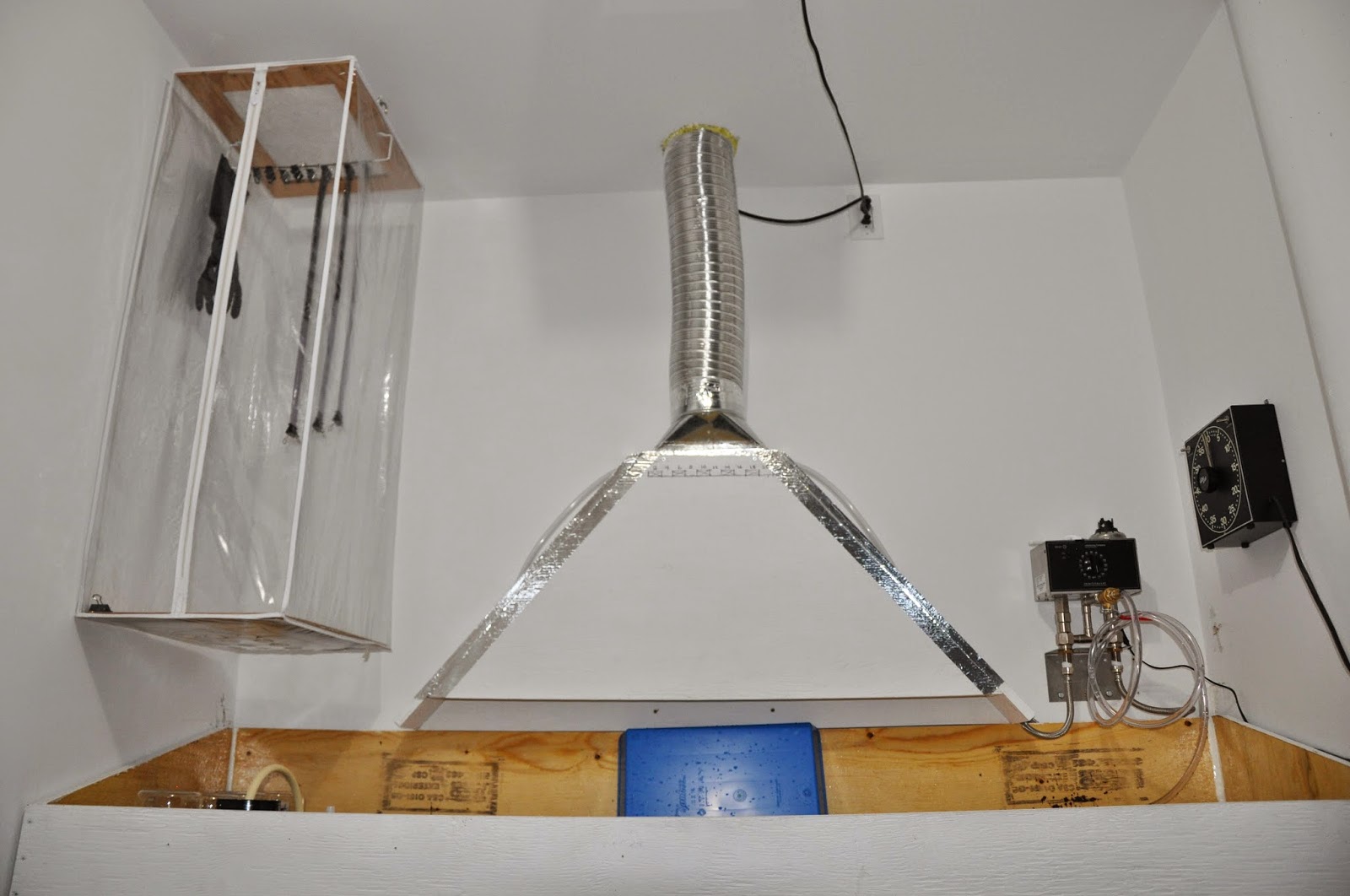
On the left is my homemade drying cabinet. In the middle is the negative venting hood. To the Right is an Intellifaucet D250, which controls the water temperature.


The sink is made out of plywood with 3 coats of marine grade epoxy for water proofing.


The room is completely air tight and this intake vent is the only way for air to enter. It is light tight and has a replaceable furnace filter inside.


Monday, February 2, 2015

Red Light in a Dark Room - Part 10

This week we take a look at how and where August develops her film. Thanks for sharing, August! Your alternative process ideas are also very interesting! Good luck, and we'd love to see how they turn out.


What is your darkroom? A room, closet or bathroom? Please tell us a bit about it.

My darkroom is in the basement of the Dunbar Community Centre; it is one of the last public darkrooms in the Parks Board system, let alone in Vancouver Proper! It has a quasi-high school sense about it. The space itself is about 6x10 ft. It's cozy, but well equipped-everything you need for a black and white set-up.

What's your process? Tell us a bit about your developing routine, especially if it's tricky.

My process is pretty basic; I strive to create master prints and consistent negatives. I've had to get a little creative with my film developing, since we don't have much space or a print dryer in the darkroom. So far, the best place to dry film is the ladies shower room, since it has separate metal stalls that you can sneakily lock from the outside.

What is your go to developer?

Hands-down, Kodak's D-76.

What is your all time favorite Film/Film developer combo?

It has to be the now extinct old-formula Agfa APX in Kodak X-Tol developer. I made such amazing contrasty black and white prints with the perfect amount of grain and tonal range-I've so far not been able to replicate it. For the last few years I've switched between Kodak T-Max and stand-by Ilford HP5, usually processed in D-76.

What result/look does this give?

HP5 gives a nice tonal range that allows a fair bit of latitude when adjusting contrast. I love TMAX when I'm shooting landscapes and urban scenes-it is fun to push and pull this film to play around with the grain.

Have you tried any or are you into any alternative processes, such as cyanotype?

Yes-I have started to experiment with making some of my own chemistry, starting with a recipe to develop film using instant coffee! I'm also planning on making my own toner dyes if I can source the chemicals, and I also want to make a film developer formula that was intended to use to record nuclear blasts in the New Mexico and Nevada test grounds.

What is the best processing tip you can give?

When it comes to processing black and white, the most important detail is the temperature of your film developer. Get a film thermometer and make sure you're exactly on. Nothing ruins a roll of film like over and under-exposure, and you have only one chance with negatives. It's a good idea to have all your chemistry at the same room temp, but the developer is critical.


Monday, January 26, 2015

Red Light in a Dark Room - Part 9

This week we are excited to take a look at Doug's darkroom! Looks like he has a great set up for printing. Thanks for the photos too, Doug.

What is your darkroom? A room, closet or bathroom? Please tell us a bit about it.

I have a Saunders LPL 6x7 Dichroic Enlarger that I set up in my bathroom. The enlarger is on top of a kitchen trolley bought at Home Depot and modified to roll over the toilet in the bathroom. I use a tray rack that lets me stack three trays on top of each other to save counter space. I also have an old 8x10 print washer for washing fibre prints (my preferred material is Ilford Multigrade FB). The challenge in my situation is that the bathroom gets hot very quickly and sadly the ventilation fan is very noisy. I am considering replacing it with something much quieter, but proper ventilation is key. I have not been printing a lot recently, but the recent purchase of a 5x7 camera is going to allow me to contact print, which I find very exciting.


 What's your process? Tell us a bit about your developing routine, especially if it's tricky.

I process roll film using the Paterson tanks. They use a little more chemistry, but I find the reels much easier to load (but they must be really dry) than the stainless steel systems. Sheet film is processed using Jobo drums. My preferred developers have been Ilfotech HC and Kodak D76. They give different looks but I find both pleasant. I have also used pyrogallol developers for landscape photos but understand the Pyrocat is a superior alternative to PMK. My developing routine is extremely repeatable. For roll film tanks, I agitate for the first 30 seconds of the first minute and for 10 seconds at every minute thereafter. Sheet films are processed in drums on constantly rotating roller bases. Developing times shift around based on how contrasty the situation is or if I am looking for extra “pop” in terms of contrast. It is valuable to test your film and developer combinations but too much testing takes away from taking pictures. I don’t really use the Zone System, but I try to understand the effects of the variables in the process. Henry Horenstien’s “Beyond Basic Black and White Photography” is an excellent book for folks who want to go further.

What's your all time favorite Film/Film developer combo?

Right now, I really enjoy Acros 100 in Ilfotech. It provides sharp, punchy images and the grain is minimal. HP5 in D76 is a real smooth combination. It’s a good general purpose combination that yields easily printed results. For longer scale scenes, the staining developers with pyrogallol are great for the separation of highlights and provides a lot of subtle gradation. I used to use it with TMX 100 (which would blow out highlights pretty easily) shot at 50 ISO.

Have you tried any or are you into any alternative processes, such as cyanotype?

I’m a bit of a nut for the alt processes and have printed both cyanotypes and platinotypes. I have done a workshop in carbon printing, but don’t have the space for the process at home. I recently completed a wet plate workshop and found the process to be fascinating and worth the effort.

The 5x7 camera I plan to be working with was bought to encourage me to work with the alt processes. The negative size is, in my opinion, the smallest that is comfortable for viewing as an image on a wall, or in a portfolio. The result of all this is that I am starting to look for a space to set up a dedicated darkroom where I can work with chemistry without wrecking my apartment (silver nitrate stains are the mark of the wet plate photographer).

What is the best processing tip you can give?

My best advice for new darkroom people is to be consistent. Make as much of it as repeatable as possible. When you want to make a change, change one thing at a time. Otherwise, you will never understand how you got something. I also feel that you should go out and shoot rather than chase magic bullets in the darkroom. Only optimize your processing to the point that you can see a difference in your prints. Though I enjoy the darkroom, I prefer to photograph.

Here are a few samples of Doug's work.


Friday, January 16, 2015

Friday Featured Film Spotlight - Ilford XP2 Super

This week we take a look at Ilford XP2 Super, Ilford's chromogenic black and white film.

XP2 Super, is the current version of Ilford's XP line of film and has been around for about 17 years. The original XP film was introduced by Ilford in 1981 and did not have quite the same exposure latitude as the current XP2 Super film. This makes XP2 a very versatile film good for all situations. A lot of wedding photographers at one time really liked the XP2, as it has quite a fine grain and good contrast for portraits.

The great part about XP2 is the fact that it is processed in C41 (color) developer, making it easier and faster (and usually less expensive) to get processed at a lab. Despite the fact that this film is not a 'true' black and white film, it has really great tonal range and I don't think most people would recognize that it is a C41 processed film. If you are familiar at all with regular black and white and color negatives however, you will notice that XP2 has an all together different tone on the actual negative. It tends to have a bit more of a warm purple hue after it has been developed.

In the days before digital became huge many professional photographers loved to shoot XP2 instead of a 'true' black & white film because XP2 could be processed along with all their color rolls in an hour if they needed it to be, no waiting around. Then depending on the photo lab the photographer used, the proof photos would be printed on colour paper but look black & white. Though quite often if the lab's machines weren't calibrated the prints would have a magenta or green hue. This was a whole other ball of wax. These days photographers interested in using XP2 can scan their negatives and drop their files into a photo editing program and correct scanning imperfections themselves. Then enlargements can be printed from the XP2 negatives on 'true' black & white paper, colour paper or digitally using inkjet paper.

Here are a few sample shots from Nicole...


Monday, January 12, 2015

Red Light in a Dark Room - Part 7

This week's darkroom post is care of Kevin, who also does some printing in his home darkroom. Thanks for the great details, Kevin!

What is your darkroom? A room, closet or bathroom? Please tell us a bit about it.

My darkroom is my 800 square foot apartment's only bathroom, because Vancouver. I'm a member of the West End Photographic Society, and as such can use their darkroom in the West End, but I live in South Burnaby so the occasional hassle of monopolizing the bathroom is kind of fun. It does mean that I can only really print when my girlfriend isn't home for a long stretch of time, but anyways...

The enlarger sits on the floor, a couple of trays are in the tub, and one is next to the enlarger. I process one print at a time due to space requirements. I have a home-built print washer that I can set up elsewhere to do hour-long plus archival washing for FB prints, or if I'm really excited, I could get some Ilford Washaid to make it quicker.

In short, it's fun. I'm working with some colleagues who may wish to re-start a darkroom co-op, so if you are someone who has space that we could rent for an affordable rate, or wish to learn more, Nicole at Beau could probably put you in touch with me. (She sure can! Email film@beauphoto.com if you are interested.)

What's your process? Tell us a bit about your developing routine, especially if it's tricky.

Developing is both a lot of fun and the bane of my existence. For colour, I ship it all out to the Lab because I'm so terrified of temperature control it's not even funny.

For B&W, I tend to use trendy experimental methods I find online. I haven't done a Caffenol-C experiment yet (soon, soon), but for a while I was doing extremely dilute HC-110 stand development. I started getting edge density issues, so I've changed to a fancy combination of Rodinal and HC-110 (the so-called Rodin110) which is 4ml of Rodinal and 1ml of HC-110. Developing time is 30mins for any film, and any ISO at box speed. 30 seconds initial agitation, followed by 3 inversions at 10, 20, and 25 minutes. I have had no significant issues with this method, though I haven't tried to push it, yet.
      
What's your go to developer?

For the longest time, it was HC-110. Now, it's Rodinal/HC-110 combined. I'm enlarging up to 11x14 at home with a 6x7 negative, so I haven't had massive grain issues at all.

What's your all time favorite Film/Film developer combo?

Oh, I'm so split right now. I was, until very recently, all about Acros 100 in HC-110. Smooth, smooth, smooth. Acros is still my heartfelt favourite film, and I'll curse Fuji the day they discontinue it, which is why they never will, I'm sure.

As of late, however, I've had exceptionally good luck with Shanghai GP3 film. Clear base, seems to have nice tonality. I haven't run into the same problems others have had with it (backing numbers chemically etched into the emulsion).

What result/look does this give?

The Acros/HC-110 combo has been beautiful tonal gradation. That continues with the Rodin110. Shanghai GP3 has been interesting because it's been tonally great lately, too.

Have you or are you into any alternative processes, such as cyanotype?

I've a 4x5 camera that I really want to do wet plate photography with. I'm tempted by emulsion lifts, or homemade paper negatives. I've never done any of this, sadly.

What I have experimented with is stand development. It's great for low-contrast, compensating developing. However, I had some real problems with edge density, due to lack of agitation. I've got a happy medium at the moment with Rodin110 and regular agitation.

What is the best processing tip you can give?
Don't underestimate the importance of agitation for not ruining your prints.


Monday, December 15, 2014

Red Light in a Dark Room - Part 3

This weeks post for our darkroom series, where we are finding out more about some of our customers home darkrooms, is from Chris. He has some interesting methods with different developers, as well as some intriguing tips... 
 
Thanks for the information and sample photos, Chris! 


What is your darkroom? A room, closet or bathroom? Please tell us a bit about it.

My darkroom is in the bathroom. It's quite handy if I have the sudden urge to go. Not so handy when someone else does.

What's your process? Tell us a bit about your developing routine, especially if it's tricky.

I shoot with my crappy toy and pinhole cameras during the day and develop at night. I have some stainless steel tanks and reels that I stole from my sister. I load them in a changing bag since my "darkroom" can't actually be made dark. (Stupid skylight!) I have an iPod Touch that I use as timer. I use the Massive Dev app which automatically times the developing and has numerous film/developer combinations. (I used to use the clock on an old Tamagotchi as a timer, but I forgot him on the counter one day and he died.) After developing I hang the film to dry in the shower and hope that no one decides to have a late night shower or cover themselves with talcum powder. From there the negs are scanned with an Epson Perfection V750 using SilverFast 8.

What is your go to developer?

I use Diafine if I'm feeling lazy. You don't have to mess with temperatures and you can develop different films in the same batch. I also use Blazinal, a.k.a. Rodinal, Ilfotec DD-X and occasionally I mix up my own Caffenol.

What is your all time favorite Film/Film developer combo?

I've developed a lot of Fomapan 100 in Diafine recently. I also Like T-Max 100 in Caffenol.

What result/look does this give?

With the Fomapan in Diafine I get nice even tones, highlights don't get blown out and shadows have nice details. It's especially good when shooting with pinhole or toy cameras.

Have you or are you into any alternative processes, such as cyanotype?

Caffenol is the most alternative process I use. 10 tsp washing soda, 1 tsp Vitamin C powder and 16 heaping tsp of no-name instant coffee in 32 oz of water. 12 1/2 minutes at 20 ℃ develops T-max 100 and gives the film a nice stain. When scanned in colour the results can be interesting. Just hold your breath when using it, it smells like concentrated dog vomit.

What is the best processing tip you can give?

If you can afford it, pay someone else to do it. Otherwise, experiment and go with what works for you. Oh, and don't waste too much time reading the advice of idiots online.

Here are a few great examples Chris has sent us!

Fomapan 100 in a Debonair toy camera and developed in Diafine.


T-Max 100 shot in a Diana toy camera, developed in Caffenol.